Python Packaging Needs a Speed Revolution

Over the past decade, Python’s packaging ecosystem has undergone a remarkable transformation — one that has been both confusing and exciting for developers. From the early days of pip to the structured reliability of Poetry, and now the lightning-fast innovation of uv, developers have navigated a fragmented yet steadily improving landscape. This blog post traces that journey, highlighting the motivations, missteps, and milestones that shaped the tools we use today. Whether you’re a seasoned developer or just starting out, understanding this evolution helps clarify the tooling chaos — and makes it easier to choose the right tool for your next project.
The Evolution of Python Packaging
The timeline below visually maps out this journey, showcasing when major tools emerged and how they influenced one another.

Timeline of major packaging tools and their influence.
-
The Early Days:
For years,pip1 has been the default tool every Python developer learns first. It’s reliable, ubiquitous, and works across nearly every environment. But it’s also relatively low-level: you often need to combine it with virtual environments (venvorvirtualenv) and dependency trackers likepip-toolsto create a full project workflow.🧰 Think of
pipas the “do-it-yourself” toolbox — flexible, but you bring the glue. -
The pipenv Moment:
An early attempt to unify environments and dependencies. While promising, it was often slow and confusing in real-world use — and never became the standard. -
PoetryArrives: Structure and Simplicity
Poetry2 introduced a higher level of abstraction. It brought in a clear project structure (pyproject.toml)3, semantic versioning, and dependency resolution with lockfiles — all while abstracting away virtual environments. It appeals to developers who want opinionated defaults and consistency without stitching together multiple tools.🛠
Poetryis the all-in-one power drill: batteries included, and it just works. -
Enter
uv: The Speed-Focused Contender
Built in Rust,uv4 reimagines Python tooling for the modern era. It’s blazing fast, offers drop-in replacements forpipandvirtualenv, and aligns closely withpyproject.tomlstandards. It’s also the backend for Rye, which aims to be aPoetry-style toolchain — but even faster.🏎️
uvis like switching from a toolbox to a Formula 1 pit crew. Speed is the selling point.
💡 Curious about Python packaging trends? Follow PyCon, PyPA, EuroPython, and more — the key hubs shaping Python’s packaging future.
Core Workflows: Installation & Virtual Environment Management
Installing dependencies and managing virtual environments are at the core of every Python project5. These isolated setups contain their own Python interpreter and installed packages, helping avoid conflicts and ensuring reproducibility. Let’s explore how the three major tools — pip, Poetry, and uv — approach these workflows.
Pip Workflow
Having already introduced pip, let’s now walk through how it fits into core workflows — particularly when managing virtual environments and installing dependencies. While pip installs packages into the currently active environment, it does not create or manage virtual environments by itself. To isolate dependencies, it’s best to use Python’s built-in venv module alongside pip.
# Create a virtual environment
python3 -m venv .venv

# Activate it
# macOS/Linux:
source .venv/bin/activate
# Windows:
.venv\Scripts\activate

# Then install packages
pip install <package>
Always run
pipcommands inside a virtual environment for better isolation and reproducibility.
Pip — Setup, Usage, and Dependency Management
# Check pip version
pip --version

# OR (more reliable)
python -m pip --version

# Install a package
pip install requests

# Install a specific version
pip install "requests==2.18.4"

# Install from requirements.txt
pip install -r requirements.txt

# Upgrade a package
pip install --upgrade requests

# Uninstall a package
pip uninstall requests

# Export current dependencies
pip freeze > requirements.txt
Poetry Workflow
Poetry simplifies dependency management and packaging by using pyproject.toml as the single source of truth. Unlike pip, Poetry automatically manages a virtual environment for our project. When we run poetry install or poetry add, it:
- Creates a virtual environment (usually in a central cache directory)
- Resolves dependencies
- Installs them into the environment
We can configure Poetry to store the virtual environment inside the project directory (rather than in the global cache) by updating config:
[virtualenvs]
in-project = true
To activate the environment manually:
poetry shell
Use
poetry runto execute scripts inside the managed environment.
Poetry — Setup, Usage, and Dependency Management
# Install Poetry (recommended way)
pipx install poetry

# Or use the official install script
curl -sSL https://install.python-poetry.org | python3 -

# Create a new project
poetry new my_project
cd my_project

# OR initialize Poetry in an existing project (creates pyproject.toml)
poetry init

# Add dependencies
poetry add requests

# Install dependencies (from pyproject.toml)
poetry install

# Update all dependencies
poetry update

# Remove a dependency
poetry remove requests

# Run a script inside Poetry’s virtual environment
poetry run python app.py

# Export dependencies to requirements.txt (if needed)
poetry export -f requirements.txt --output requirements.txt
UV Workflow
uv is like swapping your toolbox for a pit crew — built in Rust, lightning-fast, and fully automated. It doesn’t just install packages; it builds your whole environment in record time. Let’s now look at how uv fits into the core workflows of installing dependencies and managing virtual environments. uv combines both tasks into a single streamlined interface — automatically creating virtual environments, resolving dependencies, and managing packages via pyproject.toml.
- To create a virtual environment:
uv venv
UV — Setup, Usage, and Dependency Management
# Install UV
pip install uv

# OR (macOS/Linux)
brew install astral-sh/uv/uv

# Initialize a new project (adds pyproject.toml)
mkdir my-uv-project
cd my-uv-project
uv init

# Create a virtual environment
uv venv

# Add and install a package (e.g., requests)
uv add requests

# Install a package manually (pip-style)
uv pip install another-package

# Install from requirements file
uv pip install -r requirements.txt

# Freeze dependencies (like pip-tools)
uv pip compile pyproject.toml -o requirements.txt

# Sync environment from lock file
uv pip sync requirements.txt

# Remove a package
uv remove requests

# Run script within the virtual environment
uv run python my_script.py
Use
uv runto execute commands insideuv’s managed environment.
Python Packaging: The Benchmark Battle
Choosing the right Python tool for dependency management can drastically impact the development speed6. We benchmarked three popular tools — pip, Poetry, and uv — to measure their performance for:
- Virtual environment creation
- Installing lightweight packages: numpy, pandas, scikit-learn
- Installing heavyweight package: torch
Key Questions
- Which tool creates environments fastest?
- How do installation times compare for lightweight and heavyweight packages?
- What’s the end-to-end speed advantage of using a tool like
uv?
⚙️ Experimental Setup:
- Python Version: 3.8+
- OS: Linux
- CPU: 7 cores
- Memory: 15 GB
- Platform: Kubeflow notebook pod
“Times may vary slightly based on network speed and package cache state”.
- 🛠 Tools Benchmarked:
- pip (with venv)
- Poetry (with in-project virtualenv)
- uv (using its internal virtualenv and pip-like install flow)
- 📚 Dependencies:
- Light: numpy==1.24.4, pandas==1.5.3, scikit-learn==1.1.3
- Heavy: torch==1.13.1
- 📋 Conditions:
- Clean install per run (--no-cache-dir, --force-reinstall)
- 3 iterations per tool
- Timing via time.time()
- Virtualenv removed after each run
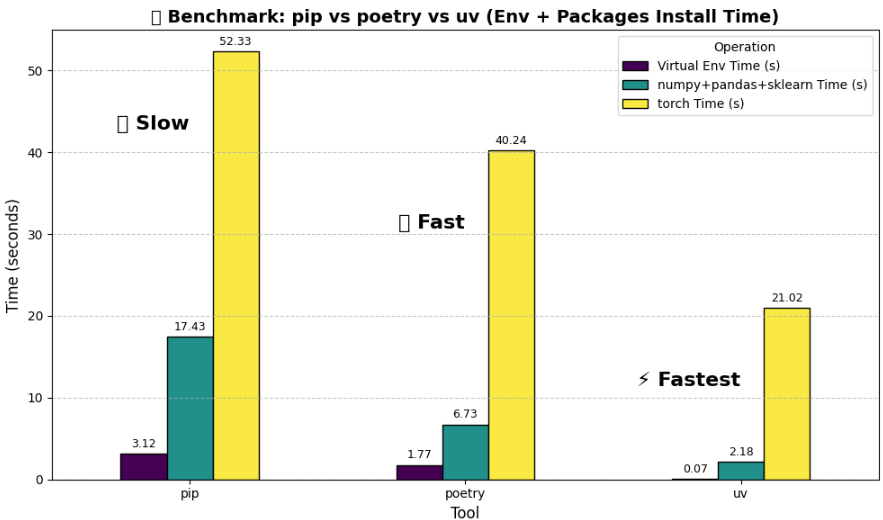
📊 Here’s what we found:
-
pipis the slowest across the board -
Poetryis faster, but still Python-bound and primarily sequential -
uvis by far the fastest:-
5x–10x faster than
piporPoetryfor lightweight installs
(e.g.,numpy,pandas,scikit-learn) -
Full install (with
torch) in ~21s, nearly
2.5x faster thanPoetryand 3x+ faster thanpip -
Up to 40x faster (<0.1s) for virtual environment creation,
thanks to its Rust-powered speed and smarter dependency resolution
-
💡 “Using
uvfor the first time feels like switching the project to SSD after years on a spinning disk.”
Beyond Speed: CLI Usability & Developer Experience
Different tools offer different trade-offs in terms of usability and feature completeness7. Here’s a quick comparison of pip, Poetry, and uv from a command-line experience perspective:
| Feature | pip | Poetry | uv | Comment |
|---|---|---|---|---|
| Dependency resolution | Manual (or pip-tools) | Built-in | Faster, smarter |
uv is Rust-based and significantly faster |
| Virtual env support | Manual (venv) |
Auto-managed | Explicit & fast |
Poetry creates & manages venvs automatically; uv expects external management or activation |
| Lock file support |
requirements.txt only |
poetry.lock |
uv.lock |
pip lacks native lock file format |
pyproject.toml support |
Partial (via PEP 517/518) | Native ([tool.poetry]) |
Flexible ([project], [tool.poetry]) |
pip reads PEP 517 build systems but doesn’t manage them |
| Publishing to PyPI | Use twine
|
Built-in | Now supported |
uv publish is available as of 2024 (experimental, but working) |
Editable install (-e .) |
Yes | Yes | Yes | All three support editable installs |
💡 Key Takeaway
If we are looking for an opinionated all-in-one tool,Poetryis great.
If we want speed with modularity,uvis compelling.
When to Use Which?
Each tool shines in different situations. Here’s a quick guide to help choose the right one depending on your needs:
| Scenario | Best Tool | Why |
|---|---|---|
| Easier to learn | Poetry |
Built-in support for dependency resolution, virtualenv, and packaging |
| Super-fast installs in CI or dev | uv |
Significantly faster env creation & installs (5x–10x faster than pip) |
| Combining best of both worlds | uv |
Handles fast installs, packaging, and PyPI publishing – all-in-one |
| Virtual environment creation | uv |
Fast and supports multiple isolated envs with ease |
| Familiar workflow & legacy compatibility | pip |
Universal and works with any Python project |
Who Benefits the Most from uv?
The transition to modern Python dependency management tools like uv isn’t just about speed — it’s about empowering specific groups to work more efficiently and effectively. Here’s who stands to gain the most:
1. Data Scientists and Machine Learning Engineers
Benefit: Rapid environment setup and reproducibility
Data professionals often need to create and manage multiple environments for experiments. uv’s lightning-fast environment creation and package installation streamline this process, allowing for more experiments in less time.
“UV combines environment creation and package management in a single tool, streamlining the workflow.”
— DataCamp Tutorial on uv
2. CI/CD Engineers & DevOps Teams
Benefit: Significantly reduced CI/CD pipeline times
In continuous integration and deployment workflows, time is critical. uv’s performance can drastically cut down the time required for dependency installation, leading to faster build and deployment processes.
“UV’s performance shines brightest in automation pipelines, where every second counts.” — Introducing uv: Next-Gen Python Package Manager
3. Open-Source Maintainers
Benefit: Simplified dependency management and contributor onboarding
Maintainers juggling multiple projects and contributors can benefit from uv’s deterministic resolution and seamless integration, making it easier to manage dependencies and onboard new contributors.
“UV’s standards-compliant virtual environments work seamlessly with other tools, avoiding lock-in or customization.”
— uv GitHub Repository
Popularity & Community Adoption
To complement the performance and feature comparison, let’s look at real-world developer interest using Google search data8:
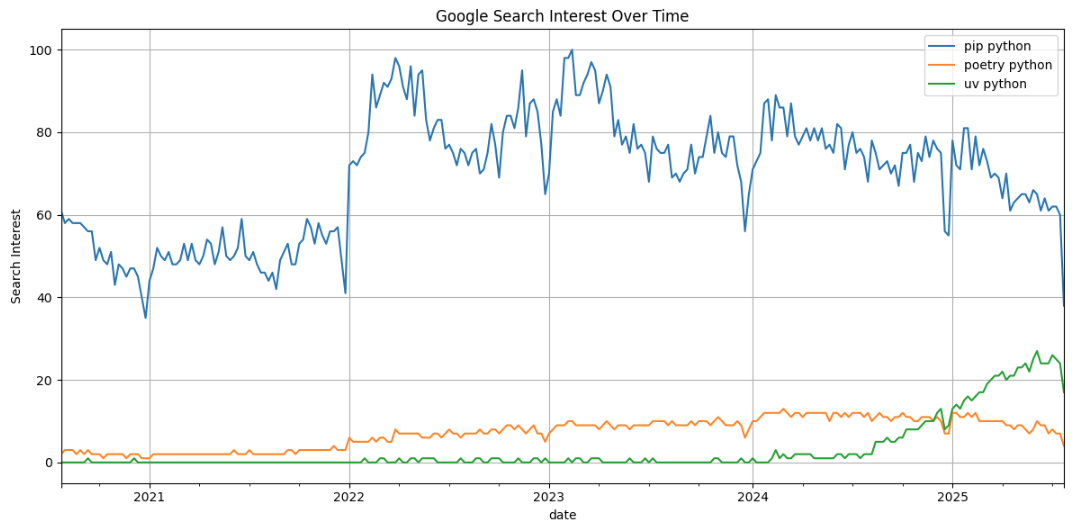
As the chart shows:
-
pipremains dominant as the default tool -
Poetryhas gained steady popularity as the structured alternative -
uv, although newer, shows an upward trend with increasing attention
So… Which One Should You Bet On?
Whether we’re accelerating machine learning experiments, streamlining CI/CD pipelines, maintaining open-source projects, teaching the next generation of developers, or building core Python infrastructure — uv offers a modern, efficient solution for dependency management.
It embodies the best of both worlds: the flexibility of pip, the structured reliability of Poetry, and the performance of a Rust-powered engine — reflecting a Python community continually evolving toward a smoother developer experience.
Each generation of packaging tools has pushed toward greater developer empowerment:
-
pipwas flexible but manual -
Poetryautomated best practices through a unified workflow -
uvbrings composability and speed — doing fewer things, but doing them exceptionally well
While the Python packaging ecosystem is still influenced by specific design choices and continues to evolve, it is now more cohesive, efficient, and developer-friendly than ever.
Choosing the right tool today involves more than just looking at features — it also requires an understanding of the journey that led us here and a focus on clarity rather than disruption in our development process9.
What’s your current Python stack? Have you tried uv yet?
🛠️ Want to try it yourself?
👉 Explore the benchmark code on GitHub – coming soon!
-
The Python Packaging Authority (PyPA) maintains
pip, the de facto standard Python package installer. Its official documentation covers CLI usage, dependency resolution, caching mechanisms, and internals. ↩ -
Poetry is a popular Python packaging and dependency management tool focused on ease of use and reproducibility. Its official site provides documentation and installation instructions at python-poetry.org. ↩
-
PEP 621 defines the standard for project metadata in
pyproject.toml, which is relevant for modern Python package managers such asPoetryanduv. See PEP 621. ↩ -
uv is a next-generation Python package manager designed for speed and efficiency, significantly outperforming
pipandPoetryin installation times. See the uv GitHub repo for details. ↩ -
The Python Packaging User Guide is the canonical resource for all Python packaging tools and standards, including
pip,Poetry,setuptools,pyproject.toml, and best practices. ↩ -
Performance comparisons among
pip,Poetry, anduvshow thatuvachieves installation speeds 10× to 100× faster, as documented in Astral’s benchmark reports at uv benchmarks. ↩ -
The Python Packaging Ecosystem Talk from PyCon provides simple guidelines and perspectives on choosing packaging tools and managing workflows involving
pip,Poetry, and other modern Python package managers. In parallel, as noted by McKinsey Digital’s From box to cloud: How to drive agile software and DevOps productivity, agile delivery models and DevOps transformations can dramatically accelerate productivity — much like how modern Python packaging tools streamline environment setup, dependency resolution, and deployment for faster, more reliable development workflows. ↩ -
Community discussions about
pip,pipx,Poetry, anduvin real-world workflows—including Docker, CI pipelines, and production environments—can be explored through their active GitHub issue trackers: pip, pipx, Poetry, and uv. ↩ -
Brett Cannon’s interview “Why Python Packaging is Hard” explores the historical and architectural reasons behind Python packaging complexity and tool fragmentation. Read it at pydevtools.com. ↩